Our Locations
Ahmedabad, Gujarat
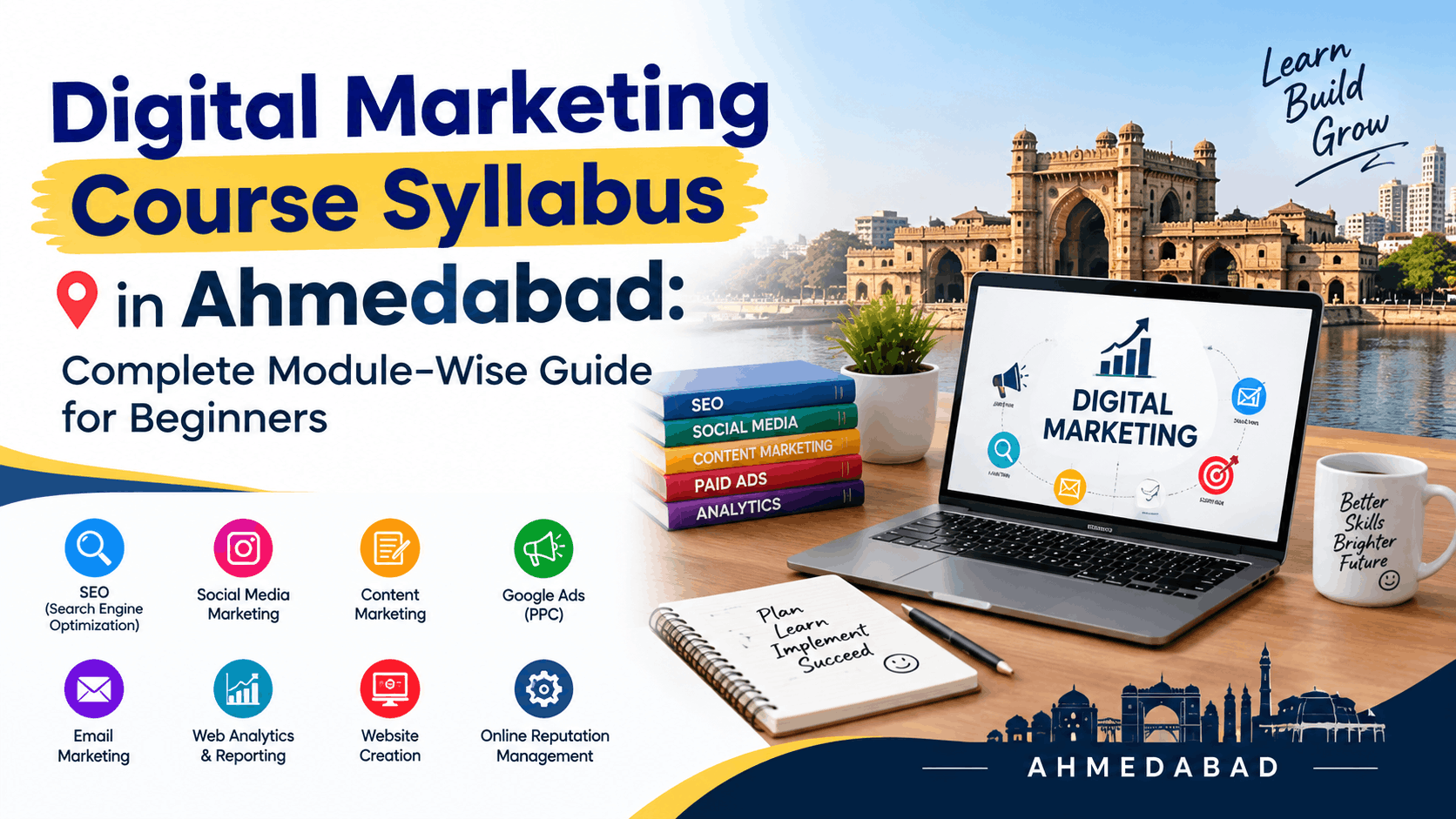
Digital marketing has become one of the most practical skills for students, graduates, entrepreneurs and working professionals who want to build a career in the online business ecosystem.
But before joining a Digital Marketing Course in Ahmedabad, one question should come before fees or certification:
What exactly will I learn?
A good digital marketing course should go beyond teaching social media posting or basic advertising. Beginners should gradually learn how search engines work, how customers discover businesses online, how paid campaigns are created, how content generates traffic, how analytics measures results and how AI is changing modern marketing.
This guide explains a complete module-wise Digital Marketing Course Syllabus in Ahmedabad, from fundamentals to advanced topics, with a focus on practical career skills.
A comprehensive digital marketing program may include:
Not every institute includes all these modules. The depth of each topic also depends on the course duration and level.
A digital marketing syllabus is a structured learning roadmap covering the major channels, tools, strategies and analytical methods used to promote products, services and brands through digital platforms.
A beginner-friendly syllabus should ideally move through three stages:
Fundamentals → Practical Channel Skills → Advanced Strategy & Analytics
This approach helps students understand not only what a digital marketing channel is, but also when, why and how to use it.
Every beginner should first understand the digital marketing ecosystem.
Students can create a basic digital marketing strategy for a local Ahmedabad business such as:
Before launching a campaign, marketers need to understand the market.
Select three competitors and prepare a comparison covering:
Website + SEO + Content + Social Media + Advertising + Customer Experience
A digital marketing campaign needs a destination.
Students should understand the basic relationship between marketing campaigns and websites.
Create a landing-page wireframe for a digital marketing course or another local service.
SEO is one of the most important modules in any digital marketing course.
Students learn how websites can improve their organic search visibility.
Perform a complete SEO audit of a website and prepare an action plan.
Local SEO is particularly important for businesses serving specific cities or areas.
For an Ahmedabad-based business, local search visibility can help potential customers discover:
Create a local SEO strategy for an Ahmedabad business.
SEO focuses on organic visibility, while paid search allows businesses to advertise within search results and other Google advertising environments.
Depending on the course, students may also learn:
Create a sample Google Ads campaign for a local business.
Social media is more than publishing posts.
Students should learn how to develop a social media strategy around business objectives.
Create a 30-day social media calendar for a business.
Organic social media and paid social advertising require different approaches.
Design a complete social advertising campaign including:
Objective → Audience → Creative → Copy → Landing Page → Conversion → Measurement
Content is the foundation of many digital marketing strategies.
Students should learn how content supports:
Digital marketers increasingly need to understand how to create content that serves both users and business objectives.
Write an SEO article targeting a specific Ahmedabad-related search query.
Email remains useful for lead nurturing, customer retention and marketing automation.
Create a three-email lead-nurturing sequence.
WhatsApp can be useful for businesses that communicate directly with prospects and customers.
Students should also understand privacy, permission and platform-policy considerations.
Video is an important component of modern digital marketing.
Create a YouTube content plan for a business or educational institute.
Affiliate marketing introduces students to performance-based partnerships.
Influencer campaigns can help brands reach niche audiences.
Create an influencer campaign proposal for an Ahmedabad-based brand.
Digital marketers working with online stores need additional skills.
Marketing without measurement is difficult to improve.
Students should understand how to interpret website and search data.
Prepare a monthly digital marketing performance report.
Performance marketing focuses on measurable business outcomes.
Students should learn to connect:
Marketing Spend → Traffic → Leads → Customers → Revenue
Lead generation is particularly important for service businesses.
Develop a complete lead-generation funnel for a local business.
Getting visitors is only one part of digital marketing.
The next challenge is converting those visitors.
Brand reputation can influence customer decisions.
Students should learn how to respond professionally rather than attempting to manipulate reviews.
AI has become an important productivity and analysis layer for marketers.
A modern course can introduce students to AI-assisted workflows for:
Students should learn how to evaluate AI output, not simply copy and publish it.
Human expertise remains important for:
Google’s current Search guidance emphasises useful, original, people-first content and warns against creating large volumes of unoriginal content primarily to manipulate search rankings.
Modern digital marketing courses increasingly introduce concepts related to AI-powered search.
GEO generally refers to improving how useful information can be discovered, understood and potentially surfaced in generative search experiences.
AEO focuses on structuring information so that direct questions can be answered clearly.
AIO is commonly used as a broader term for adapting content, workflows and digital assets to AI-driven discovery and marketing.
Students can learn to:
Google’s 2026 guidance specifically addresses generative AI features and explains that established SEO best practices remain relevant.
Advanced digital marketing programs may introduce automation concepts.
The objective is to reduce repetitive work while maintaining useful customer communication.
A professional digital marketer should know how to communicate results.
Depending on the campaign:
Create a digital marketing dashboard or monthly performance report and explain what improved, what declined and what should be changed next.
This is one of the most important parts of a career-oriented digital marketing course.
Students should ideally complete multiple projects rather than only examinations.
Project 1: SEO audit of a website
Project 2: Keyword research and content plan
Project 3: Google Ads campaign structure
Project 4: Social media calendar
Project 5: Local SEO strategy
Project 6: Content marketing campaign
Project 7: Lead-generation funnel
Project 8: Analytics performance report
Project 9: E-commerce marketing strategy
Project 10: AI-assisted marketing workflow
A portfolio gives employers something concrete to evaluate.
| Module | Main Topics | Level |
|---|---|---|
| Digital Marketing Fundamentals | Strategy, funnel, audience | Beginner |
| Market Research | Competitors, audience, positioning | Beginner |
| Website Fundamentals | Website, landing pages, CTA | Beginner |
| SEO | On-page, technical, off-page | Beginner–Advanced |
| Local SEO | GBP, local search, citations | Intermediate |
| Google Ads | PPC, keywords, campaigns | Intermediate |
| Social Media | Strategy, content, engagement | Beginner–Intermediate |
| Social Ads | Targeting, campaigns, retargeting | Intermediate |
| Content Marketing | Strategy, distribution | Beginner–Intermediate |
| Copywriting | Blogs, ads, landing pages | Beginner–Intermediate |
| Email Marketing | Campaigns, automation | Intermediate |
| WhatsApp Marketing | Communication, leads | Intermediate |
| YouTube Marketing | Video SEO, analytics | Intermediate |
| Affiliate Marketing | Partnerships, tracking | Intermediate |
| Influencer Marketing | Campaigns, creators | Intermediate |
| E-commerce Marketing | Product, marketplace, conversion | Advanced |
| Analytics | GA, Search Console, reporting | Intermediate |
| Performance Marketing | CPL, CPA, ROAS | Advanced |
| Lead Generation | Funnels, forms, nurturing | Intermediate–Advanced |
| CRO | Landing pages, testing | Advanced |
| ORM | Reviews, reputation | Intermediate |
| AI Marketing | Research, content, analysis | Intermediate |
| GEO/AEO/AIO | AI search visibility | Advanced |
| Automation | Workflows, CRM, nurturing | Advanced |
| Reporting | KPIs, dashboards | Intermediate |
| Projects | Portfolio, campaigns | All Levels |
If you are completely new to digital marketing, you don’t need to master everything simultaneously.
A practical progression is:
Learn:
Digital Marketing → Audience → Funnel → Customer Journey
Study:
SEO → Local SEO → Content Marketing
Study:
Google Ads → Social Advertising → Remarketing
Study:
Social Media → Email → WhatsApp → YouTube
Study:
Analytics → Search Console → Reporting → KPIs
Study:
Landing Pages → Lead Generation → CRO → Performance Marketing
Study:
AI Tools → Automation → GEO → AEO → AI Search
This sequence makes the learning process easier for beginners.
Students should focus on building a broad foundation.
A recommended combination is:
SEO + Content + Social Media + Google Ads + Analytics + AI
Students should also create at least two or three portfolio projects before applying for internships or entry-level jobs.
Working professionals may not need to study every module in equal depth.
Instead, choose modules according to your career goal.
SEO + Technical SEO + Local SEO + Analytics + Content
Google Ads + Social Ads + Analytics + Landing Pages + CRO
Social Media + Content + Social Ads + Analytics + Influencer Marketing
Google Ads + Social Ads + Analytics + CRO + Lead Generation + ROAS
Digital Strategy + Local SEO + Social Media + Ads + Analytics + Lead Generation
DMG IT Engineering & Multimedia Institute offers an Advanced Certificate in Digital Marketing in Ahmedabad.
According to the institute’s current published course information, the program has a 9-month duration and is available in online and offline modes. The syllabus covers a broad set of digital marketing areas including Digital Marketing Strategy, SEO, SEM, Google Ads, Social Media Marketing, Content Marketing, Email Marketing, YouTube Marketing, WhatsApp Marketing, Affiliate Marketing, Influencer Marketing, Google Analytics, Google Search Console, AI-powered marketing tools, Performance Marketing, Lead Generation, Website Optimization, Online Branding and Campaign Management.
The institute describes the program as an Advanced Certificate in Digital Marketing and states that the certificate is approved by MIT, Government of India. Students should verify the latest certificate wording, approval details, fees, batch timings and admission conditions directly with the institute before enrollment.
For beginners comparing digital marketing institutes in Ahmedabad, the important question is not simply:
“How many modules are included?”
Instead ask:
“How deeply will I practise each module?”
A syllabus containing 30 topics is not necessarily better than a syllabus containing 15 topics if the first provides only superficial exposure.
Look for a balance of:
Theory + Demonstration + Assignment + Practical Project + Analysis + Feedback
Before paying the course fee, ask the institute:
Does the syllabus include practical projects?
Will students work with real websites or campaign examples?
Are analytics and reporting included?
Does the course teach local SEO?
Does it cover Google Ads and conversion tracking?
Is AI taught as a practical workflow rather than just a list of tools?
Does the course explain current search developments such as AI Overviews and AI-powered search?
Will students create a portfolio?
Are internships available?
Who issues the course certificate?
These questions can help you distinguish between a theory-focused course and a career-oriented training program.
The duration depends on how deeply each module is taught.
1–2 months
Usually focuses on fundamentals and selected channels.
3–6 months
Provides broader coverage with practical assignments.
6–12 months
Can include advanced SEO, paid advertising, analytics, performance marketing, AI, projects and career preparation.
The number of months is less important than the actual learning hours, practical exposure and project quality.
No.
Most digital marketing beginners can start without programming knowledge.
However, basic technical understanding can become useful for areas such as:
You do not need to become a professional programmer to build a career in digital marketing.
Digital marketing is broad rather than necessarily difficult.
The challenge is that the industry contains many different disciplines.
For example:
SEO requires patience and analytical thinking.
Google Ads requires campaign and data analysis.
Social media requires creativity and audience understanding.
Analytics requires interpretation of data.
Content marketing requires research and communication skills.
A structured syllabus helps beginners learn these areas progressively.
A career-oriented beginner should ideally be able to:
A comprehensive syllabus generally includes digital marketing fundamentals, SEO, local SEO, Google Ads, social media marketing, content marketing, analytics, email marketing, performance marketing, lead generation, AI marketing and practical projects.
Start with digital marketing fundamentals, customer journey, audience research and marketing funnels before moving into SEO, advertising and social media.
Yes. SEO is generally one of the core modules of comprehensive digital marketing programs.
Many professional and advanced programs include Google Ads, PPC, campaign structure, keyword targeting and conversion tracking.
Many updated programs now introduce AI-assisted research, content, analytics, automation and campaign workflows. The depth varies by institute.
There is no single skill that is most important for every role. SEO, paid advertising, content, analytics, social media and performance marketing are valuable depending on the career path.
Yes. Digital marketing is a practical discipline. Projects help learners convert theoretical concepts into demonstrable skills.
A comprehensive program can take several months. Advanced programs may run for 6–12 months depending on depth and practical training.
Yes. Many digital marketing programs are suitable for students after Class 12, subject to individual institute eligibility requirements.
Yes. Online, offline and hybrid programs can allow professionals to learn around their existing schedules.
A strong Digital Marketing Course Syllabus in Ahmedabad should not simply contain a long list of tools.
It should teach students how different marketing channels work together:
Research → Strategy → Content → SEO → Advertising → Engagement → Analytics → Conversion → Retention
The most valuable syllabus combines foundational knowledge with practical execution.
For beginners, the ideal learning path is to first understand digital marketing fundamentals, then develop core skills in SEO, Google Ads, social media, content and analytics, followed by advanced areas such as performance marketing, AI, automation, GEO and AEO.
If you are evaluating DMG – Digital Marketing Training Institute in Ahmedabad, its currently published Advanced Certificate in Digital Marketing provides a broad 9-month curriculum with online and offline learning options and coverage across SEO, Google Ads, social media, analytics, performance marketing, lead generation and AI-powered marketing tools. Verify the latest program details before admission.
Ultimately, don’t choose a course because it has the longest syllabus.
Choose the syllabus that gives you the deepest practical understanding of the skills you actually want to use.