Our Locations
Ahmedabad, Gujarat
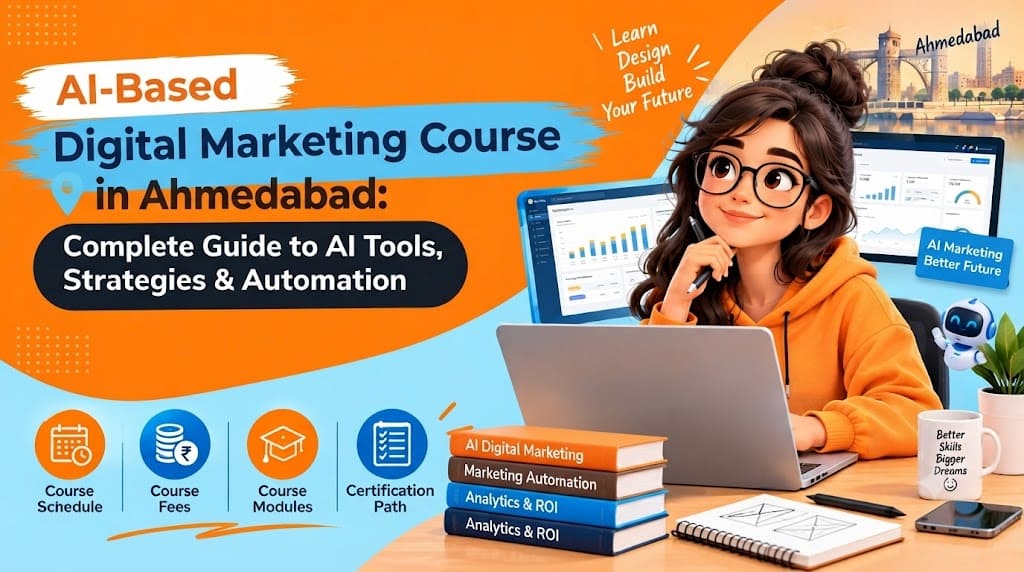
Artificial intelligence is changing the way businesses plan campaigns, create content, analyze customers, optimize advertisements, and measure marketing performance. As AI tools become part of everyday marketing workflows, learning AI-based digital marketing can help students, freshers, entrepreneurs, and working professionals develop skills that go beyond traditional digital marketing.
If you are searching for an AI-based digital marketing course in Ahmedabad, it is important to understand what the course actually teaches. A modern program should not simply add a few AI tools to an existing digital marketing syllabus. It should explain how AI can be integrated into SEO, content creation, paid advertising, social media, analytics, automation, customer research, and marketing strategy.
This complete guide explains the AI-based digital marketing course syllabus, fees, duration, practical training, AI tools, career opportunities, certifications, and important factors to check before enrolling in Ahmedabad.
An AI-based digital marketing course combines traditional digital marketing skills with artificial intelligence tools and workflows.
Instead of learning SEO, social media, advertising, and content marketing separately, students learn how AI can support these activities.
A comprehensive AI digital marketing course may cover:
The goal is not simply to learn AI tools. It is to understand when, where, and how AI can improve a marketing workflow while keeping human strategy, creativity, fact-checking, and decision-making involved.
AI-based digital marketing refers to using artificial intelligence technologies to support marketing activities such as research, content creation, customer analysis, advertising, personalization, automation, and performance reporting.
Traditional digital marketing often requires marketers to manually perform repetitive tasks.
For example:
Traditional workflow:
Research → Write → Design → Publish → Analyze → Optimize
AI-assisted workflow:
Research → AI-assisted ideation → Human review → Create → Publish → AI-assisted analysis → Human optimization
AI can help marketers save time, generate ideas, identify patterns, and automate repetitive processes. However, marketers still need to check accuracy, brand suitability, originality, privacy considerations, and campaign performance.
Ahmedabad has a diverse business environment that includes startups, manufacturing companies, education providers, e-commerce businesses, service businesses, financial organizations, healthcare companies, real-estate firms, and local retailers.
These businesses increasingly use digital channels to attract customers.
AI skills can add another layer to traditional digital marketing knowledge by helping marketers work more efficiently with:
For students and freshers, learning both digital marketing fundamentals and AI applications can create a broader skill set than learning isolated AI tools.
The exact syllabus varies between institutes, but a career-oriented program should ideally combine marketing fundamentals with practical AI applications.
Before using AI, students need to understand marketing fundamentals.
Topics may include:
Understanding these concepts is essential because AI tools cannot replace the need for a clear marketing objective.
A dedicated AI module can introduce students to generative AI and effective prompting.
Students may learn:
The focus should be on using AI to solve marketing problems, rather than memorizing individual prompts.
SEO is changing as search engines and AI-powered search experiences evolve.
An AI-focused SEO module may cover:
Students should also understand that AI-generated content still needs originality, accuracy, usefulness, and human review.
Content creation is one of the areas where AI can significantly assist marketers.
Students may learn how to use AI for:
However, effective content should not simply be copied from an AI tool. Human editing, brand voice, original insights, examples, and factual verification remain important.
AI is increasingly used in paid advertising platforms for campaign optimization and automation.
An AI-based digital marketing course can teach:
Students should learn the marketing logic behind campaigns rather than relying completely on automated recommendations.
AI can support social media teams with research, ideation, content planning, and creative workflows.
A course may cover:
Students can also learn how to adapt one piece of content into multiple formats for different platforms.
Modern marketing often requires visual content.
Depending on the institute, students may be introduced to AI-assisted tools for:
Students should understand copyright, licensing, brand guidelines, and disclosure requirements where applicable.
AI can help marketers personalize and automate parts of email campaigns.
Topics may include:
The practical goal is to understand how automation can reduce repetitive work while maintaining relevant customer communication.
Data is one of the most valuable areas for AI-assisted marketing.
Students may learn how to use AI to help interpret:
For example, an AI tool may help summarize a large marketing report, identify unusual changes, or suggest questions for further investigation.
The marketer should still verify the underlying data before making business decisions.
Automation can connect different stages of a marketing workflow.
A course may introduce:
The exact tools depend on the institute and current industry practices.
The cost of an AI-based digital marketing course in Ahmedabad can vary significantly depending on the duration, syllabus, practical projects, tools, trainer support, certification, and placement services.
Indicative fee categories may look like:
| Course Type | Approximate Duration | Indicative Fee Range |
|---|---|---|
| Basic AI + Digital Marketing | 1–2 months | ₹8,000–₹20,000 |
| Professional AI Digital Marketing | 3–6 months | ₹20,000–₹50,000 |
| Advanced AI Marketing Program | 4–8 months | ₹30,000–₹75,000+ |
| Specialized AI Marketing Training | 1–3 months | ₹7,000–₹30,000+ |
These are general market-oriented ranges, not fixed Ahmedabad-wide prices. Individual institutes may charge more or less depending on what their programs include.
Do not compare only the total course price.
Check whether the fee includes:
A lower-priced course may cover fewer tools or projects, while a more expensive program may include additional practical training.
Course duration depends on the depth of the program.
A short-term course may focus on AI tools and basic digital marketing concepts, while a professional program can take several months.
A possible six-month learning structure is:
Learn marketing concepts, customer journeys, funnels, SEO basics, and digital channels.
Learn keyword research, content optimization, local SEO, technical fundamentals, and AI-assisted SEO workflows.
Learn content strategy, social media marketing, AI-assisted content creation, and content calendars.
Learn paid advertising, campaign structures, targeting, creatives, conversion tracking, and optimization.
Learn marketing analytics, reporting, automation, CRM workflows, and AI-assisted data interpretation.
Complete practical projects, build a portfolio, prepare a resume, and practice interviews.
Practical work is especially important because knowing how to use an AI tool is different from solving a marketing problem.
A good course may include projects such as:
Choose a business and develop:
Create a monthly social media strategy including:
Develop a sample Google Ads or Meta Ads campaign with:
Analyze campaign or website data and create:
Create a basic workflow showing how a lead can move from:
Ad → Landing Page → Lead Form → CRM → Email → Follow-up → Conversion
These projects can later become portfolio pieces.
The tools taught depend on the institute and its current curriculum.
Possible categories include:
Used for brainstorming, content assistance, research support, and marketing workflows.
Used for keyword research, competitor analysis, technical audits, and performance monitoring.
Used for campaign creation, audience targeting, reporting, and optimization.
Used to measure traffic, engagement, conversions, and campaign performance.
Used for generating or modifying marketing visuals and creative concepts.
Used to connect applications and automate repetitive marketing workflows.
A good course should teach how to choose the appropriate tool for a specific task, rather than simply providing a long list of AI software.
AI can automate or accelerate many repetitive marketing tasks, but digital marketing involves more than content production.
Marketing professionals still need to:
Therefore, students should aim to become AI-enabled marketers, not simply AI-tool operators.
After developing practical skills, learners can explore roles such as:
| Job Role | Typical Work |
|---|---|
| Digital Marketing Executive | Managing online marketing activities |
| SEO Executive | Search optimization and content strategy |
| AI Content Specialist | AI-assisted content workflows |
| PPC Executive | Paid advertising campaigns |
| Social Media Executive | Social media planning and management |
| Performance Marketing Executive | Campaign performance and optimization |
| Content Marketing Executive | Content planning and production |
| Marketing Automation Executive | Automated marketing workflows |
| Digital Marketing Analyst | Marketing data and reporting |
| AI Marketing Specialist | Applying AI to marketing processes |
Actual job requirements vary between employers. Some positions may require experience with specific advertising, analytics, CRM, or SEO platforms.
This type of course can be useful for:
You do not necessarily need a computer science background.
Basic computer knowledge and an interest in marketing are enough to begin learning. Analytical thinking and communication skills can become increasingly useful as you move toward advanced roles.
The difference is primarily in how technology is incorporated into the marketing workflow.
| Area | Traditional Approach | AI-Assisted Approach |
|---|---|---|
| Content ideas | Manual research | AI-assisted ideation + human review |
| Keyword research | Manual analysis | AI-assisted research and clustering |
| Content creation | Primarily manual | AI-assisted drafting + editing |
| Advertising | Manual optimization | Platform automation + AI assistance |
| Data analysis | Manual reporting | AI-assisted summaries and pattern identification |
| Customer research | Manual collection | AI-assisted organization and analysis |
| Automation | Basic workflows | More advanced automated workflows |
AI does not eliminate the fundamentals of digital marketing. Instead, it can change how efficiently those fundamentals are executed.
Before enrolling, ask the institute these questions:
Check whether AI has dedicated modules or is only mentioned in promotional material.
Ask for the current tool list and understand what practical work you will perform with them.
Ask whether you will create campaigns, content strategies, SEO plans, reports, and automation workflows yourself.
Projects are valuable for building practical experience.
Check the trainer’s professional experience and teaching background.
Ask who issues the certificate and whether it is an institute certificate, industry certification, or qualification linked to a recognized skill framework.
Ask for specific details instead of relying only on phrases such as “100% placement.”
Some tools have free versions while others may require separate subscriptions or credits.
AI tools and marketing platforms change rapidly. A modern curriculum should be reviewed periodically.
For freshers, the value of an AI-focused course depends largely on what they actually learn and practice.
A useful combination is:
Digital Marketing Fundamentals + AI Tools + Practical Projects + Analytics + Portfolio + Communication Skills
Learning only AI prompts without understanding marketing fundamentals may not prepare you for a complete digital marketing role.
Similarly, learning only traditional marketing methods without understanding current AI-assisted workflows may leave you with fewer opportunities to automate repetitive tasks.
The strongest learning approach is to combine both.
A portfolio can demonstrate your practical ability to employers.
You can include:
Always clearly distinguish between sample/simulated projects and campaigns that were actually run.
Certification requirements vary from one institute to another.
Before enrolling, identify whether you will receive:
A certificate should not be treated as proof of practical expertise by itself.
For employment, employers may also consider:
If an institute claims that its certificate is “government-approved,” verify the claim with the relevant issuing or accrediting authority.
It is a digital marketing program that combines SEO, social media, advertising, content marketing, analytics, and other marketing fundamentals with artificial intelligence tools and workflows.
AI tools can assist with content research, writing, brainstorming, SEO workflows, advertising analysis, social media planning, design, automation, and data interpretation. The exact tools depend on the marketing task and course curriculum.
Fees vary by institute, duration, syllabus, practical training, certification, and placement services. Professional programs may range from around ₹20,000 to ₹50,000, while advanced programs can cost more.
Yes. Beginners can start with digital marketing fundamentals and gradually learn AI-assisted workflows. No advanced programming background is normally required.
Coding is generally not required for most digital marketing roles. Basic technical knowledge can nevertheless help with website, SEO, analytics, and automation-related tasks.
It can help you develop relevant skills, but completing a course does not guarantee employment. Practical projects, portfolio quality, communication, experience, and employer requirements also matter.
No. AI-generated content still needs human review for accuracy, originality, usefulness, search intent, brand voice, and factual reliability.
Yes. Freelancers can use AI-assisted workflows for research, content planning, social media, reporting, and repetitive marketing tasks. They still need to understand the client’s business objectives and deliver measurable results.
Basic concepts can be learned within weeks, but developing professional-level skills usually requires several months of structured learning and practical projects.
Compare the syllabus, AI tools, practical projects, trainer experience, fees, certification, course duration, placement terms, reviews, and whether the institute provides hands-on campaign practice.
Before paying the course fee, check:
☑ Digital marketing fundamentals
☑ SEO and AI-assisted SEO
☑ Google Ads/PPC
☑ Meta Ads
☑ Social media marketing
☑ Content marketing
☑ AI content workflows
☑ Prompt engineering
☑ Marketing analytics
☑ AI-assisted reporting
☑ Marketing automation
☑ Practical projects
☑ Portfolio development
☑ Certification details
☑ Trainer experience
☑ Placement-assistance terms
☑ Updated AI curriculum
The ideal learning journey should move through:
Learn → Practice → Create Projects → Analyze → Build Portfolio → Apply for Jobs
AI can make digital marketing workflows faster and more scalable, but strong marketing fundamentals remain the foundation.
For students and professionals in Ahmedabad, an AI-based digital marketing course can therefore be approached as a combination of marketing knowledge, technology skills, analytical thinking, and practical application.