Our Locations
Ahmedabad, Gujarat
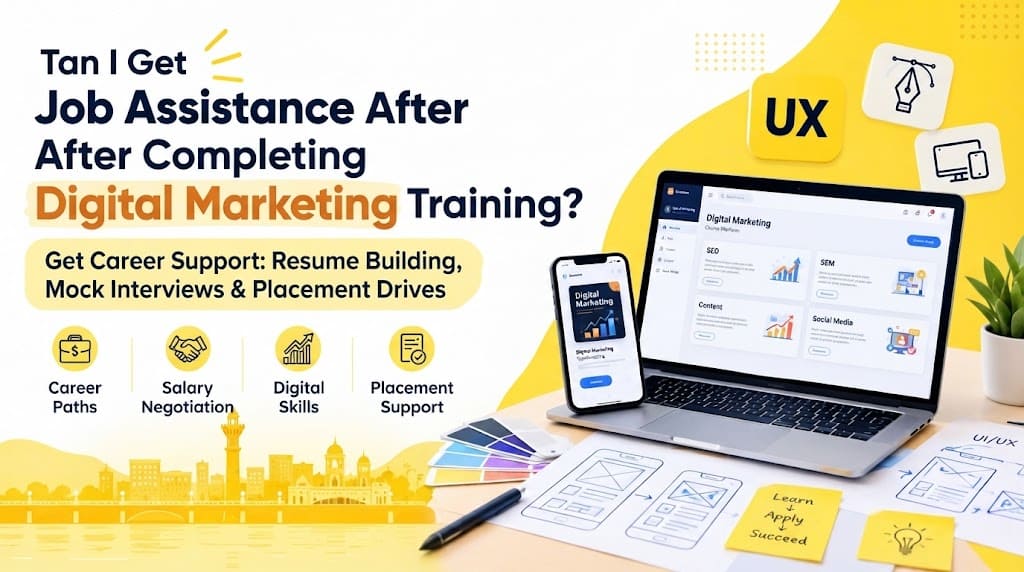
Yes, you can get job assistance after completing digital marketing training, but the type and quality of assistance depend on the training institute, your skills, practical experience, portfolio, and interview preparation.
Digital marketing has become an important career option for freshers, graduates, career changers, and professionals looking to build skills in online marketing. However, completing a course alone does not automatically guarantee a job. The right digital marketing training with placement assistance can help you move from learning concepts to preparing for real job opportunities.
If you are wondering, “Can I get a job after completing a digital marketing course?”, the answer is yes—provided you develop practical skills and actively participate in the job-search process.
Yes. Many digital marketing training institutes provide job assistance after course completion.
Job assistance may include:
However, job assistance is different from a guaranteed job placement. A good institute helps you become job-ready and connects you with relevant opportunities, while your selection depends on your skills, performance, experience, and the employer’s requirements.
Job assistance is a career-support service offered by some digital marketing training institutes to help students find suitable employment after completing their training.
Instead of simply giving you a certificate, a career-focused digital marketing institute may support you throughout the transition from training → practical skills → portfolio → interview → job.
For example, after completing training, you may receive support with:
Digital Marketing Skills → Practical Projects → Portfolio → Resume → Interview Preparation → Job Opportunities
This process can make the job search more organized, especially for freshers who do not know how to present their skills to employers.
The exact services vary between institutes, but several types of digital marketing career support are commonly offered.
A digital marketing resume should show more than course completion.
It should highlight practical skills such as:
A strong resume should also demonstrate what you have actually done during training.
For example:
“Created an SEO content strategy and performed keyword research for a practical project.”
This is more valuable than simply writing:
“Completed an SEO course.”
Recruiters frequently use professional networking platforms to discover candidates.
A job-oriented digital marketing training program may help you improve:
Your LinkedIn profile should clearly communicate what digital marketing skills you have and what type of role you are looking for.
Interview preparation is another important part of job assistance.
You may practice questions such as:
Mock interviews can help freshers become more confident when answering practical questions.
One of the biggest advantages of practical digital marketing training is the opportunity to create projects.
Employers often want to know:
“What can you actually do?”
A portfolio gives you an opportunity to demonstrate your skills.
A beginner digital marketing portfolio can include:
Your portfolio can become especially important when you have limited professional experience.
Some digital marketing institutes provide internship assistance after or during training.
An internship can help you gain exposure to:
For freshers, an internship can provide valuable practical experience and strengthen the resume.
Some institutes have relationships with companies, agencies, startups, or recruitment partners.
They may share relevant openings with students or recommend eligible candidates.
Possible entry-level positions include:
The availability of these roles depends on the current hiring market and your location, skills, and experience.
Yes, freshers can apply for digital marketing jobs after completing training.
You do not necessarily need years of experience to begin a career in digital marketing.
However, you should understand an important difference:
Course completion ≠ job readiness.
To become job-ready, you should combine your training with:
Learning + Practice + Projects + Portfolio + Interview Preparation + Job Applications
For example, someone who has completed an SEO course but has never performed keyword research may find it difficult to answer practical interview questions.
On the other hand, a fresher who can explain their SEO project, show their keyword research process, discuss technical issues, and explain how they measured results can make a stronger impression.
A beginner does not need to master every digital marketing specialization immediately.
Start with the fundamentals and gradually develop practical expertise.
Digital Marketing Fundamentals → SEO → Content Marketing → Social Media Marketing → Google Ads/PPC → Analytics → Email Marketing → Practical Projects → Portfolio → Interview Preparation → Job Applications
You can later specialize in areas such as:
Digital marketers increasingly work with performance data.
Learning basic data analysis can therefore give you an additional advantage.
A useful beginner roadmap is:
Excel → Data Cleaning → Statistics → SQL → Power BI/Tableau → Data Visualization → Python → Projects → Portfolio → Internship/Job
The basic concepts can be understood as:
Data Analytics → Data → Cleaning → Analysis → Insights
Data Visualization → Charts → Dashboards → Data Storytelling
Data Analyst → Excel → SQL → Power BI → Statistics → Python
These skills can complement digital marketing because marketers need to understand campaign performance, customer behavior, traffic, conversions, and business results.
A typical job-assistance process may look like this:
Learn the fundamentals and major digital marketing channels.
Work on realistic marketing tasks instead of only watching lectures.
Document your projects, strategies, analysis, and results.
Create a role-specific resume focused on measurable skills and projects.
Make your profile searchable and professional.
Prepare both theoretical and practical digital marketing questions.
Apply for internships, fresher positions, agencies, startups, and in-house marketing roles.
Use your projects and portfolio to demonstrate your practical knowledge.
If you do not get selected, identify gaps and improve your skills before the next interview.
No.
This is one of the most important things students should understand before joining a training program.
Job assistance generally means that an institute helps you with the job-search process.
Guaranteed placement is a much stronger claim and should be carefully examined.
Before joining a digital marketing course, ask:
Do not choose an institute only because it advertises a high placement percentage.
Job assistance can open doors, but you still need to be prepared.
Here are practical ways to improve your chances.
Create projects that demonstrate your ability to solve marketing problems.
Show your work rather than simply listing courses.
Depending on your specialization, explore tools used for SEO, analytics, advertising, social media, content, and reporting.
Learn concepts such as:
Digital marketing professionals often communicate with clients, managers, designers, developers, sales teams, and content teams.
Do not depend entirely on your institute.
Apply through multiple channels, including company career pages, professional networks, recruitment platforms, referrals, internships, and direct outreach.
If your main goal is employment, ask these questions before paying for a course.
Getting clear answers can help you compare institutes more effectively.
Digital marketing includes many tasks that can be performed remotely, including:
However, remote work is not guaranteed simply because you complete a digital marketing course.
Remote opportunities depend on the employer, role, experience, skills, location, and hiring requirements.
Yes.
Digital marketing is a skills-oriented field, and people from different educational backgrounds can enter the industry.
A degree can be useful, but practical skills, communication, analytical thinking, creativity, portfolio quality, and relevant experience can also play an important role.
For a fresher, a strong combination can be:
Education + Digital Marketing Certification + Practical Projects + Portfolio + Internship + Interview Skills
There is no universal timeline because it depends on your existing knowledge, learning speed, practice time, and target role.
A structured beginner approach could look like:
Digital marketing fundamentals + SEO basics
Content + social media + keyword research
Google Ads/PPC + analytics
Advanced practice + projects + portfolio
Resume + LinkedIn + mock interviews + job applications
The exact timeline can be shorter or longer depending on your learning schedule and career goal.
Modern digital marketing is changing beyond traditional search engine optimization.
SEO helps websites improve their visibility in search engines.
GEO focuses on making content useful and discoverable within AI-powered search and generative-answer experiences.
AIO focuses on creating and structuring content so that AI systems can understand, process, summarize, and potentially surface useful information accurately.
AEO focuses on providing direct, clear answers to questions so content can perform well in answer-focused search experiences.
For digital marketers, understanding these areas can help them create content that is:
Search-friendly + User-focused + AI-readable + Answer-focused
Voice search has increased the importance of conversational content.
People may search using questions such as:
“Can I get a digital marketing job after completing a course?”
“Which digital marketing skills should a fresher learn?”
“How can I get a digital marketing job without experience?”
Therefore, digital marketing professionals should understand conversational keywords, long-tail keywords, question-based content, local search intent, and natural-language queries.
This is particularly useful when creating content for search engines, answer engines, AI platforms, and voice assistants.
Yes. You can apply for entry-level digital marketing jobs after completing training. Your chances improve when you combine training with practical projects, a portfolio, interview preparation, and consistent applications.
No. Not every course provides placement or job assistance. Always check exactly what career support the institute offers.
Yes. Digital marketing can be a suitable career option for freshers who are willing to learn practical skills and continuously update their knowledge.
Common entry-level roles include Digital Marketing Executive, SEO Executive, Social Media Executive, PPC Executive, Content Marketing Executive, and Digital Marketing Intern.
You do not generally need advanced programming skills to start digital marketing. Basic technical understanding can be helpful, especially for SEO, analytics, websites, and tracking.
Yes. Freshers can apply for internships and entry-level roles. Building practical projects and a portfolio can help demonstrate your capabilities when you have limited professional experience.
Both can be useful, but practical skills and the ability to demonstrate what you can do are especially important during job applications and interviews.
Compare the curriculum, practical projects, trainers, tools, portfolio support, internship opportunities, mock interviews, career services, company connections, and transparency of placement claims before enrolling.
Yes, you can get job assistance after completing digital marketing training, but you should choose your training program carefully.
The best career-focused programs do more than provide a certificate. They help you develop practical skills, complete projects, create a professional portfolio, prepare your resume, improve your LinkedIn profile, practice interviews, and connect with relevant job opportunities.
Remember this career formula:
Digital Marketing Training → Practical Skills → Projects → Portfolio → Resume → Interview Preparation → Job Applications → Career
If you are a fresher, do not focus only on finding a course that promises placement. Focus on becoming job-ready.
The strongest combination is:
Skills + Practice + Portfolio + Communication + Consistent Job Search = Better Career Opportunities
Digital marketing is a continuously evolving field. By learning SEO, content marketing, social media, paid advertising, analytics, data visualization, and emerging areas such as GEO, AIO, AEO, and voice-search optimization, you can build a broader and more future-ready digital marketing skill set.